The web being slow is a choice (and it’s a very stupid choice)
My neighborhood recently got high-speed fiber, and we can now get 5 Gbps for $125/month.
This is a miracle for somebody who grew up with a 56K modem. But I was shocked to find out that even with lightning-fast internet, the web can still feel very slow.
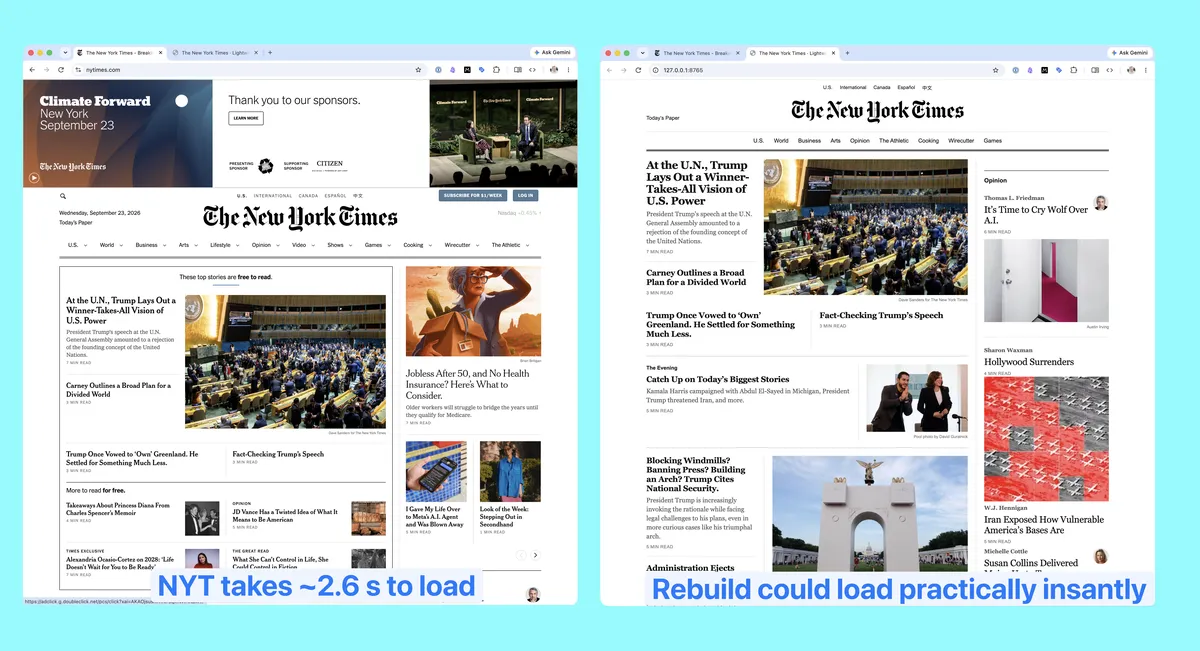
If I pull up the NYT, for example, it takes ~2.6 seconds for the page to finish loading. It's got tons of javascript, ads, trackers, and other crap.
I’m on one of the most sophisticated websites in the world. They made ~$2 billion in subscription revenue last year.
But the homepage still has code for LiveRamp’s advertising identity system, Google’s DoubleClick, Media.net ad bidding, and TONS of other third-party services.
I had Codex rebuild the NYT homepage for me without the junk, and the whole thing comes to 239 KB with compressed HTML and 32 images. It cut 89% of the HTML and image files and 100% of the JavaScript, by using static HTML, inline CSS, and compressed images.
Unsurprisingly, the page looks pretty much the same.
If a computer action takes less than .1 seconds, the human brain will register it as instantaneous. Transferring our entire 239 KB page in that time requires about 19.2 Mbps, which is very achievable for most Americans.
U.S. download speeds increased 174% from 2020 to 2024. 5 Gbps is almost 90,000x the bandwidth I had in 1996. So why are we’re still dealing with slow, bloated websites?
We’ve made incredible efforts to increase internet speeds and cache websites at the edge, but we’re spending too much of that progress on ad shit.
We have the technology to make far more of the web feel instant. It’s time to make speed one of the primary elements of good design.
The web being slow is a choice (and I think it's a very stupid choice).